Autonomous AI · smart-contract security
KTHULHU Overmind
Autonomous, AI-driven smart-contract security auditing — engineered for near-zero false positives through adversarial certainty and formal verification.
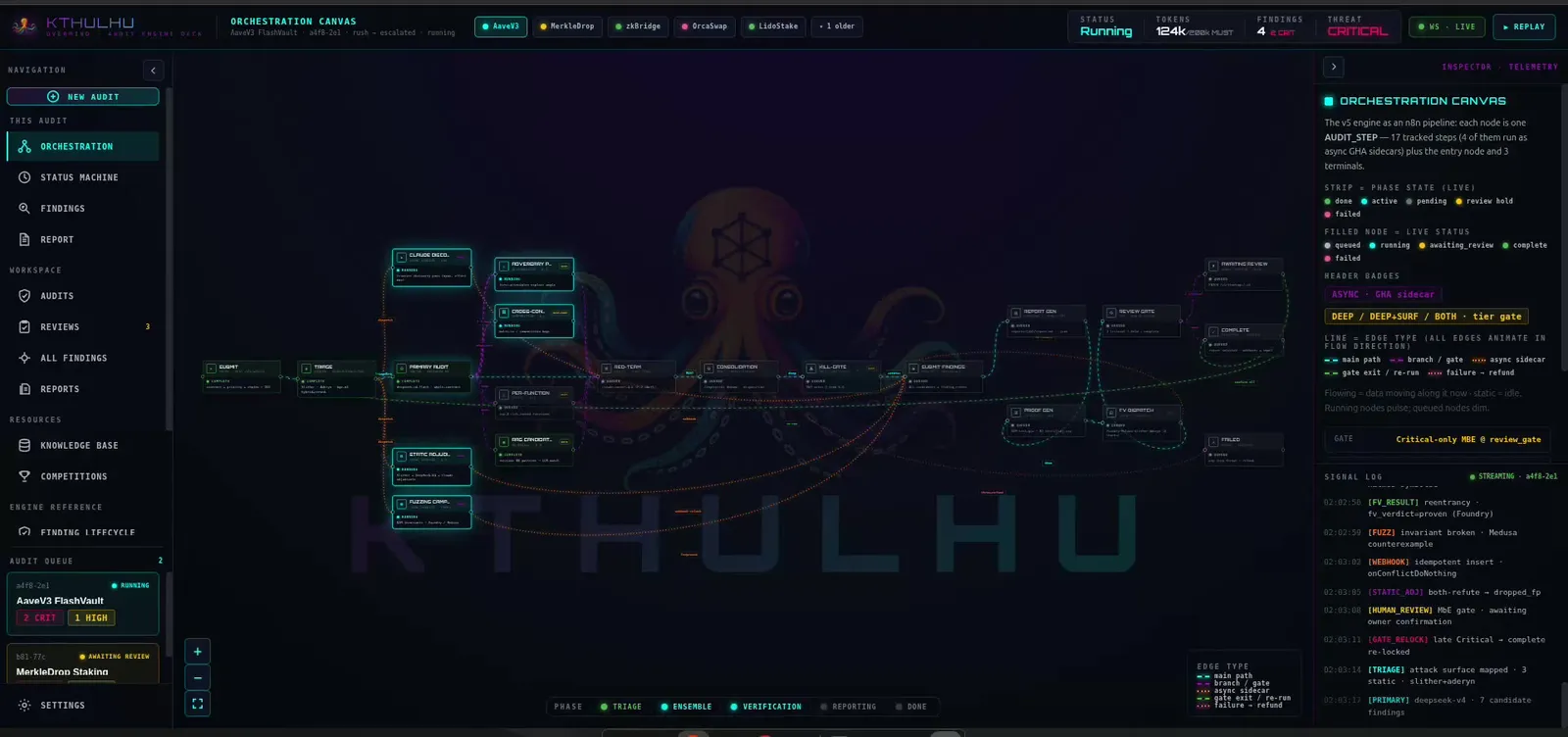
An enterprise-grade, autonomous smart-contract auditing platform. It orchestrates specialised AI agents, formal-verification tools, and dynamic blockchain forks to turn probabilistic auditing into mathematically verified vulnerability detection — live on kthulhu.co with active user audits and a USDC credit system.
See it in action
Product walkthrough · 4:16The problem
Traditional AI-powered auditors share the same failure modes:
- Context blindness — LLMs hallucinate without seeing real execution paths.
- False-positive epidemic — reports routinely claim 90%+ noise from lexical bias and stochastic reasoning.
- No mathematical proof — vulnerabilities reported without formal verification or exploit confirmation.
- Single-model risk — no adversarial red-teaming to challenge the reasoning.
Tier 1 — Foundational swarm
Sourcing & triage: a unified ingestion pipeline that normalises diverse source formats into structured analysis.
- Continuous ingestion of public contracts from GitHub, blockchain RPC, and security competitions.
- Scope-aware ingestion with 200KB / 40-file caps and nSLOC counting.
- Attack-surface mapping via repository-skeleton injection for cross-contract context.
- Chunked map-reduce primary hunter for efficient distributed analysis.
Tier 2 — Ensemble reasoning
Adversarial certainty: reasoning decomposed into atomic, independently verifiable units to drive down false positives.
- Primary reasoning — Claude Opus for enterprise-grade analysis.
- Verification skeptic — GPT-OSS-120B via Cloudflare Workers AI for aggressive red-teaming.
- Chain-of-Verification — independent agents challenge every finding.
- Typed scenario decomposition — cross-file recall lifted from 50% to 66.7%.
Tier 3 — Formal verification
The bleeding edge: mathematical proof of viability — every reported bug reproduces in a test.
- Halmos — bounded symbolic execution generating provable invariants.
- Medusa + hevm — property-based fuzzing and symbolic execution to surface invariant violations.
- Ephemeral forks — isolated, containerised Anvil mainnet forks spin up per audit for risk-free proof-of-concept testing.
- Execution-path tracing — every finding traced back to actual bytecode execution.
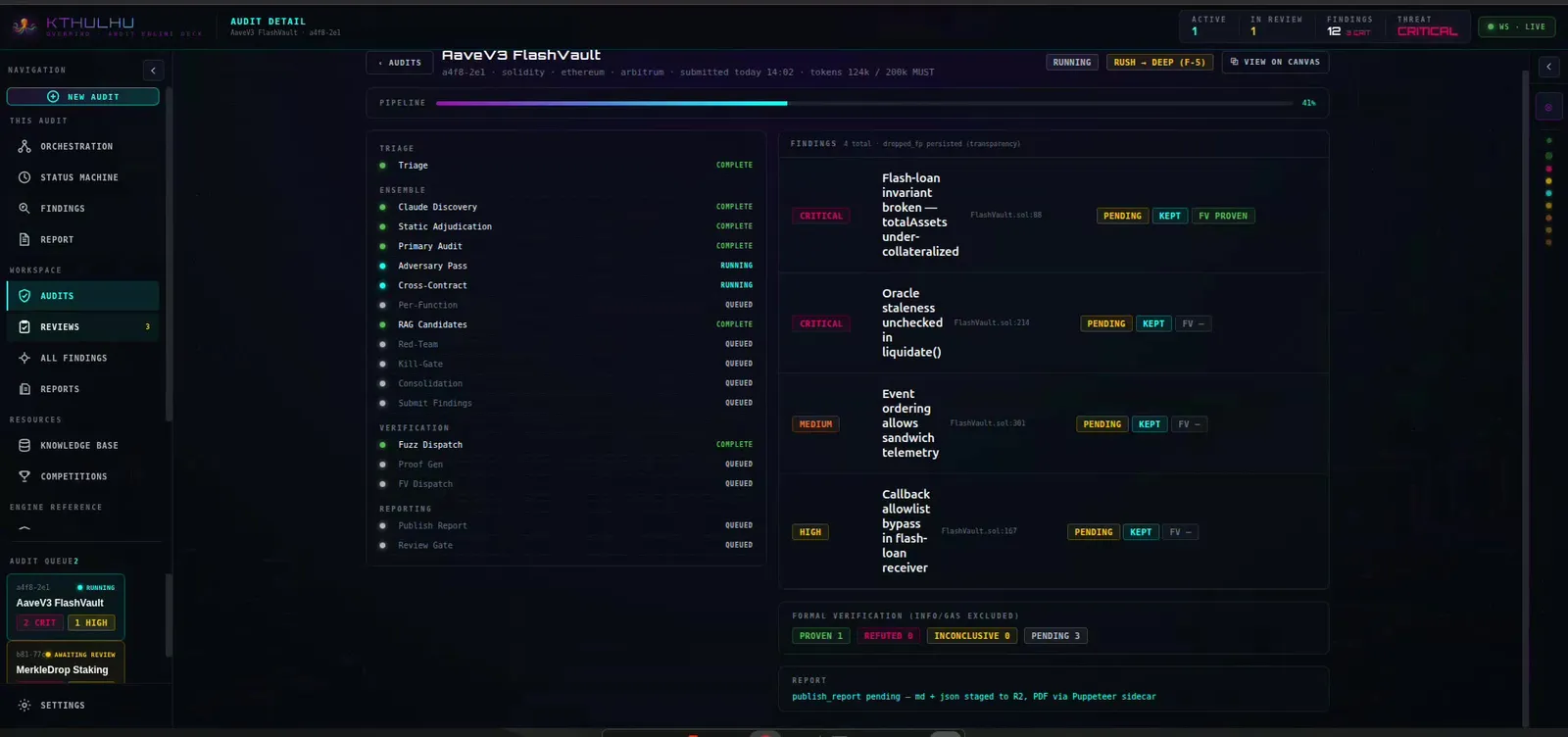
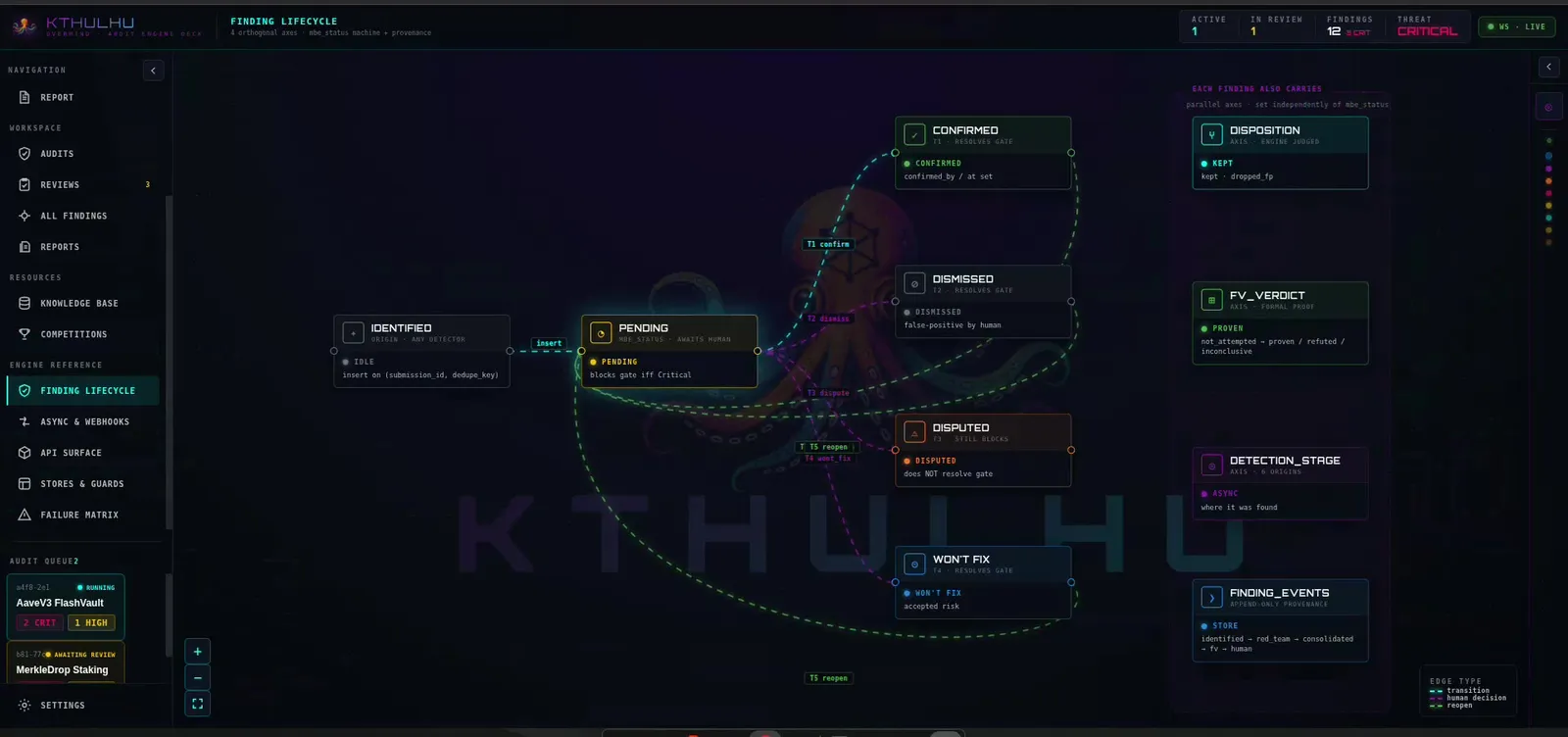
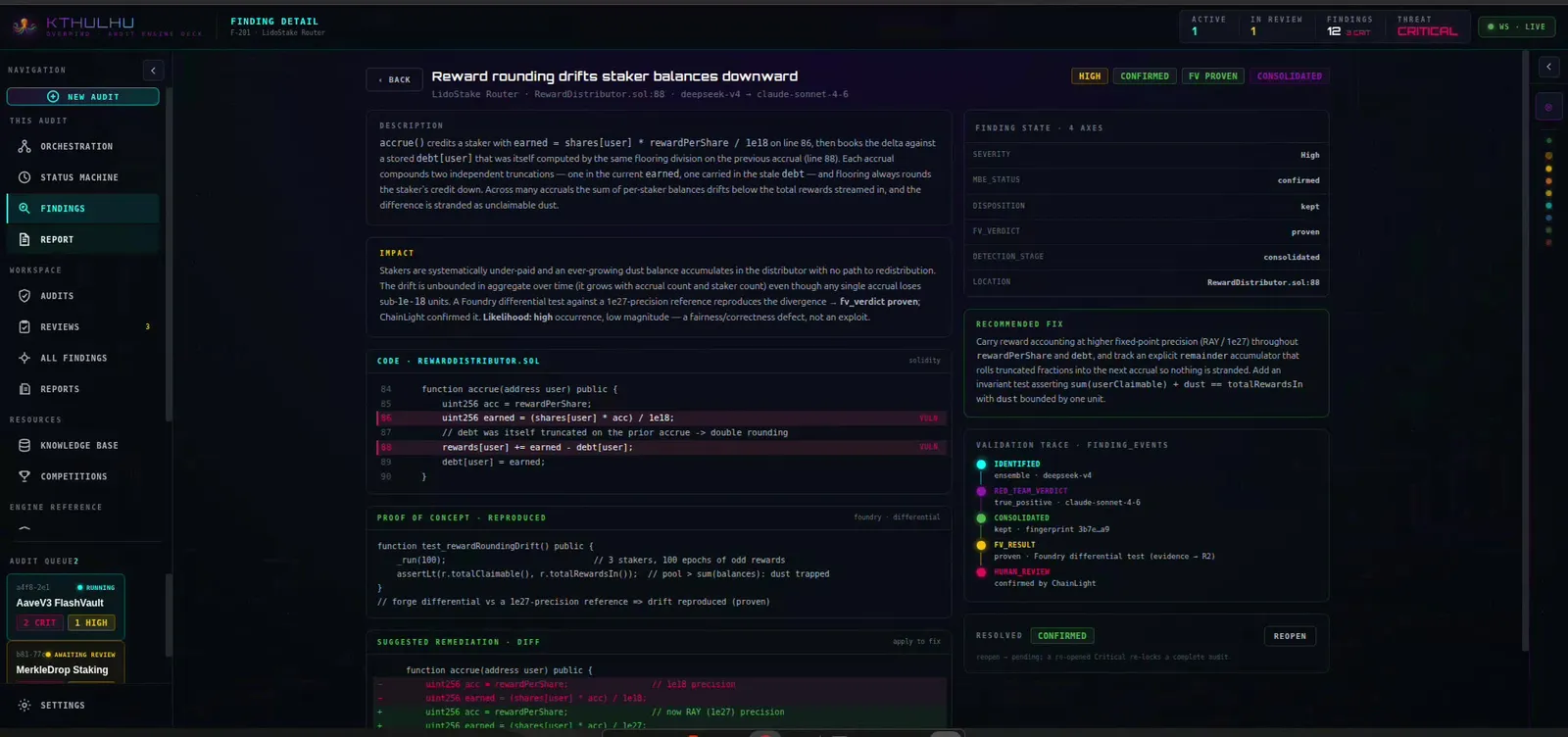
Inside the product
Built with
Want one built like this?
The engineering behind KTHULHU Overmind is available for your system.